Buffalo Illustrated Morning Express, January 30,
1898
THING OF THE PAST. ____ Narrow-gauge
Railroads of the Oil Country. ____ Hidden By Under-Brush ____ Little Left
to Represent the Vast sums of Money Invested in this Enterprise- Country
Stages Have Taken the Place of Some of the Roads ____ Special to the Buffalo
Express.
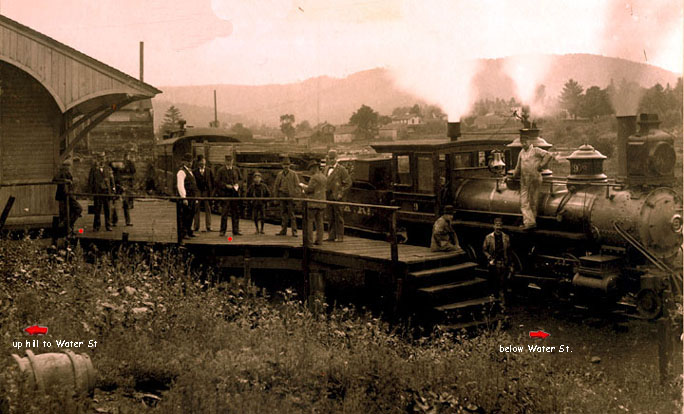
Bolivar, Jan. 29, 1898. - One of the most picturesque features
of the Northern oil fields, the narrow-gauge railroads, will soon be a thing
of the past. One after another, in the wake of the oil boom, they have been
ripped up and sent to the junk pile after serving a useful purpose. The
only thing left to represent the millions of capital once invested in these
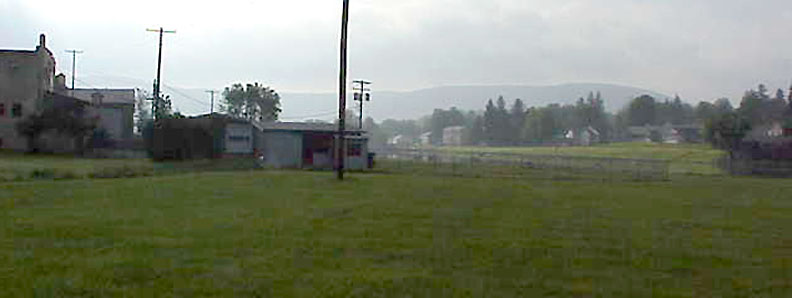
railroad enterprises are long stretches of graded right of way, almost hidden
by underbrush, weather-beaten stations, solitary and alone, with broken
platforms, doors wrenched from hinges, and open windows through which the
winter winds blow great rifts of snow; dismantled trestles, and here and
there the stone pillars of pretentious bridges, the timbers of which have
been pulled apart and carted away. The roads were built over the mountains
and around sharp curves where it would be impracticable to construct standard
gauge lines. No filling-in was done. Every gully and swamp was trestled
with hemlock, and the space between the ties was ballasted with nothing
more than the dirt that was shoveled out of the ditches. Many of the farms
that were cut up by the narrow gauges do not show it now; the land has been
reclaimed by the original owners, many of whom received fancy prices for
the right of way that is again under cultivation. The engineers who staked
out the roads were appalled by nothing in some places the grade was over
260 feet to the mile, and one high trestle followed another over a string
of gullies. Today there are only two short spurs of narrow gauge in operation
in the Northern oil fields, the Central New York & Western's 18-mile
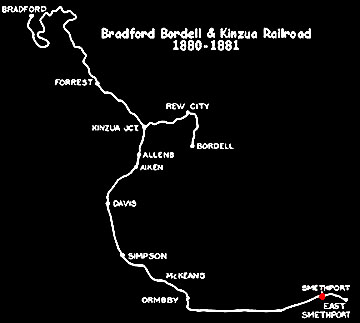
stretch that connects Bolivar with Olean, and the Bradford, Bordell &
Kinzua which climbs over the hills that rise between Bradford and Smethport,
a distance of 28 miles. The changes that have taken place in this section
of country in fifteen years are marvelous. In 1882, in the flush of the
oil boom, the Allegany Central was completed from Olean to Angelica, and
did an immense business. Bolivar and Richburg were as full of life as new
mining camps and thre were many other lively towns along the line of the
road. Richburg was the king bee with 8,000 population and had the reputation
of being the hottest oil town on the map. The Allegany Central's freight
record for the first 30 days after the road was running footed up over $12,000,
and that was before a station was built. A box car answered for the freight
and ticket office as well as waiting room, and the telegraph instrument
was screwed on the top of a dry goods box in one corner of the car. The
passenger traffic was enormous. Ten passenger and four freight trains were
run over the road every day and when there were exceptionally good attractions
at the Richburg theaters special trains were run from the towns along the
line. The passenger rates were five cents a mile and freight rates stiff,
but no one kicked for the air was full of greenbacks. That was when Richburg
boasted of a morning and evening newspaper, two banks, a hundred hotels,
a dozen doctors and an equal number of lawyers, eight saloons, dance houses
and everything else that went to make up a boom city. One of the young lawyers
who drifted in with the boom earned $3,000 fees the first three months he
was there. Bolivar with 6,000 population was not far behind either in the
volume of business transacted or in general wickedness. The Allegany Central
soon had opposition. The Wellsville, Bolivar & Eldred, later the Bradford,
Eldred & Cuba, was quickly built from Eldred to Wellsville, where connection
was made with the Erie railroad. Some lively little towns sprung up along
the line. Allentown, midway between Bolivar and Wellsville, was one of them.
Allentown had 1,000 population at one time. The Bradford, Eldred & Cuba
bjuilt a branch line a mile up the valley from Bolivar to Richburg. Seventeen
trains a day each way were run over this short line and for several months
as many as 800 people a day rode on the "dinky" road, as it was
nicknamed. A branch line was built over the mountains from Little Genesee
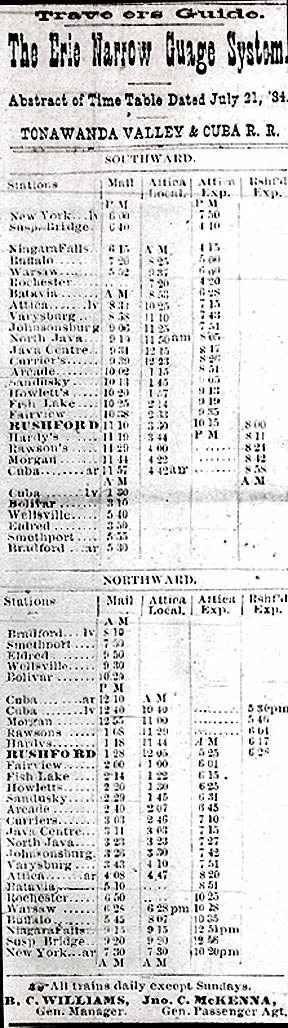
to Cuba to connect with the Tonawanda Valley narrow gauge which ran from
Attica to Cuba. the line was to give the Bradford, Eldred & Cuba an
outlet to Buffalo but neither the Cuba branch or the Tonawanda Valley road
paid operating expenses and both were long ago ripped up. When the Cuba
branch was built it was believed that the Bolivar oil field extended clear
across the county in the direction of Cuba but the guess was wrong. The
Bradford, Eldred & Cuba connected at Eldred with the Bradford, Bordell
& Kinzua and through trains were run from Bradford to Wellsville. With
the waning of the oil boom came the gradual death of the narrow gauges in
this field. Richburg has declined from a city of 8,000 to a village of 409,
as the census taken a few days ago showed, giving it the distinction of
being the smallest incorporated village in the State. All of its push and
glory has departed, though it has twice the population it had before the
boom came. Five years ago the last narrow-gauge rail that connected it with
the outside world was pulled up and now a daily stage is the only conveyance
that passes through the once prosperous city. Bolivar, which had 5,000 population
in 1882, now shows a trifle under 1,200. It has settled to be a steady-growing
country town and is still eight times larger than it was when the oil men
came. The Bolivar field still produces 700,000 barrels of oil a year and
will continue to for a decade at least, but the rush and boom have on for
good. The once busy life has given way to comparative inactivity. After
the oil boom subsided, the Bradford, Eldred & Cuba road thrived for
a short time on the lumber interests along the line, but as soon as these
were exhausted the road began to lose money. Thomas C. Platt was appointed
receiver. About all that was turned over to him were a worn-out roadbed
and worn-out rolling stock,or two streaks of rust and right of way. He kept
the wheels going until he saw that the road must either be rebuilt and new
rolling stock bought, or torn up. the outlook for business was not encouraging
and the road was knocked down to a New York broker in 1893. The track went
to a Florida lumber road. Even the interest on the bonds was defaulted for
several years and the holders of the bonds never saw even the color of their
original investment. The road earned $150,000 the first year, but after
that the earnings rapidly declined. The little stub line of the Allegany
Central now known as the Central New York & Western is the last strip
of narrow gauge left in the Allegany oil field forms a link in an interesting
bit of railroad history. Soon after the Allegany Central was completed from
Olean to Friendship, George D. Chapman, a clever promoter, came up from
New York and secured control of the road, and at once extended it from Friendship
to Angelica. That was in 1882 when the road was making money hand over fist.
Then he built a standard gauge line from Angelica to Wayland to connect
with the Delaware, Lackawanna & Western, and secured control of a couple
of other short standard gauge lines. He equipped all of his lines with superb
rolling stock, his narrow gauge division having the largest narrow gauge
engines in the world. he operated his lines on a lavish scale and when money
ran short he re-organized the road, changing the name of it and had a new
issue of bonds printed. His control was absolute,owing to his extreme cleverness.
On his standard gauge line he built the Stony Brook viaduct, the highest
structure in the state. It is built of steel, 700 feet long, 246 feet high,
and cost $70,000. Over the Erie tracks, at Swains, he built a hemlock horseshoe
trestle 1,865 feet long at a cost of $22,000. Chapman maintained an office
on Wall Street and put on more style with his little 91 miles of railroad
than the Prince of Wales would have a right to. When he came to Angelica
from New York, he cut a wide swath, and it was his custom to always toss
a silver dollar to the boy who happened to be handy to hold his team, while
he stepped out of his carriage for a moment. He induced one wealthy Friendship
man to invest $150,000 in stock in his railways and many other gave him
similar amounts. In all, he disposed of several million dollars' worth of
stocks and bonds, on which, it is declared, not a dollar's interest or principal
was ever paid. When the oil boom declined and the earnings of the road fell
off, the employees went on strike for wages. The stockholders went for Chapman,
and in July, 1892, he was deposed and the road sold. It is now owned by
a company of New York men of whom Maj. John Byrne is at the head. One standard
gauge spur was ripped up and the narrow gauge from Bolivar to Angelica was
also torn up. The narrow gauge roads of he Bradford oil field, across he
state line, have met the same fate. The Kendall & Eldred, one of the
best paying lines built during the oil boom, has been pulled u p. there
were half a dozen red hot towns along its line in 1882. Duke Center and
Rixford were hummers. The conductor's cash collections averaged $400 a day
for many months. The Bradford field was then on the top wave of prosperity.
Every train that ran over the road was packed with passengers, and some
days they loaded down the pilot of the engine, and the platforms and roofs
of he coaches. The freight business was immense. The rates were high, but
were never questioned, for the was no competition. The employees made big
money. Many a time an oil producer in a hurry for a freight car tipped the
conductor a $20 bill to hurry it along. A stage line now connects Duke Center
and Rixford with the world outside. The Olean, Bradford & Warren narrow
gauge, long operated as a feeder of the Western New York & Pennsylvania
system, wound over the hills from Olean to to Bradford. After lying idle
for a year or two, it was last summer widened out and converted into an
electric road by a company of Boston capitalists, who built a health resort
on the summit of Rock City. In some places the grade of this road is 360
to the mile, and it has many sharp curves. the line is 22 miles long. The
extension from Bradford to Marshburg is still rusting, and will soon be
torn up. The main line of the Bardford, Bordell & Kinzua, from Kinzua
Junction to Eldred, has been abandoned, but the line is still in operation
from Bradford to Smethport. It is due to the Hon.William S. Bissell of Buffalo
that this last bit of narrow gauge is now in existence. The road was originally
built from Bradford to Eldred. When it was proposed to build a branch line
from Kinzua Junction to Smethport, the move was bitterly opposed. It was
finally decided by one vote, and Mr. Bissell cast the deciding vote. Fifteen
years ago some of the liveliest little oil towns in the State boomed along
the Bradford, Bordell & Kinzua, for it traverses some of the richest
producing region of the Bradford field. After the wild rush was over the
towns gradually began to decay, and where once stood prosperous towns, there
is hardly a habitation today. Tall oil derricks loom up in every direction,
and the ride over the mountains is very picturesque. In leaving Bradford,
the railroad makes a detour 3 1/2 miles to get 2,000 feet up the mountain
side. Often a passenger missing the train at the station has followed a
path up the face of the mountain and caught the train at the summit. It
requires two engines to pull a train of five cars up the steep grade. Many
high trestles are crossed by this line, and it winds about the mountains
in a very bewildering way. In 1881 the road carried 190,000 passengers,
and paid 33 percent in dividends on its capital stock of $350,000. When
the oil boom spent its force and the lumber was about exhausted, the road
was re-organized, the debts declared off, and new rails, ties and rolling
stock bought. This road cost $14,000 a mile, and is now equipped with 40-pound
steel rails and 28-ton engines. It is remarkable that there have been so
few accidents in the history of the narrow gauge roads. The only accident
in the history of the Bradford, Bordell & Kinzua was a terrible one.
In January, 1884, a 250-barrel tank full of oil burst and the oil ran down
over the snow onto the track, forming a pool between the rails for a long
distance. The Smethport passenger train, of two coaches and a baggage car,
dashed into the flood of oil. The firebox ignited the gas and oil, and in
an instant the train was a blazing mass. Four of the 68 passengers were
burned to death, and several were badly injured. Engineer Patsy Sexton stuck
by his engine and tried to run the train through the river of fire. His
eyes were burned out, and he is now living in New York. The passengers escaped
into the snow by breaking out the windows, the flames making it impossible
to open the doors. The cab was burned off the engine, and there was not
a splinter left of the cars. the accident happened on the hill, three miles
out of Bradford. |